


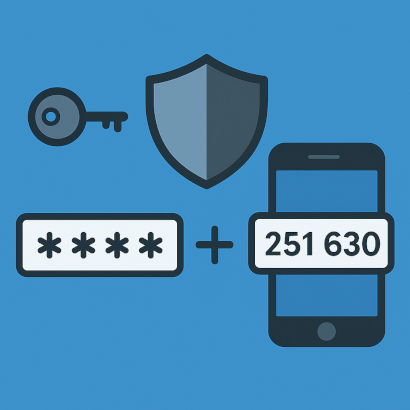
As an IT consultant, I experience firsthand how dramatically the digital threat landscape has evolved in recent years. Cyberattacks are no longer rare incidents but a daily risk. Data breaches, compromised accounts, and automated brute-force attempts clearly show:
A password – no matter how clever – is no longer enough.
Why Passwords Alone Are No Longer Sufficient
Passwords are a security factor based on knowledge — something I know.
But this factor has become increasingly vulnerable:
- Passwords appear in massive databases of leaked login credentials.
- Attackers use automated tools to guess even complex combinations.
- People reuse passwords across multiple platforms.
- Phishing attempts have become highly sophisticated.
That last point is especially critical: even a strong password becomes useless if it is entered into a perfectly forged phishing page. That’s where two-factor authentication truly shines.
What Two-Factor Authentication Really Provides ✔️
2FA adds a second layer of protection by introducing something I have or am.
Common second factors include:
- A one-time password (OTP) from an authenticator app 📱
- A hardware security key (e.g., YubiKey)
- A biometric factor such as fingerprint or face recognition
This makes a stolen password practically worthless. Even if an attacker knows it, they still cannot access the account without the additional factor.
I like to describe it this way:
The password is the key, but the second factor is the additional deadbolt on the door. 🔒➕
A Real-World Example: Protection Against Phishing 🎯
Some time ago, a client told me about an email that looked exactly like a message from a well-known cloud provider — same layout, same colors, same wording.
He entered his password before realizing it was a phishing site.
Thankfully, because of 2FA, no harm was done.
During login, the attacker would have needed a one-time code generated only on the client’s smartphone — a code valid for just 30 seconds. Without that code, the compromised password was useless.
Authenticator apps like Synology Secure SignIn, Microsoft Authenticator, or Google Authenticator are easy to set up and highly effective. The OTP codes remain stored locally on the device, offering excellent protection against remote attacks. ⏱️🔐
For the Pros: Running a Self-Hosted Two-Factor Server 🧩
In many projects, I meet advanced users and companies who prefer complete control over their authentication infrastructure. Fortunately, modern tools make this possible.
One powerful solution is the open-source software 2Fauth.
Combined with Docker, it allows the operation of a fully self-hosted OTP server, enabling complete management of authentication tokens within one’s own environment.
Of course, this option is geared toward experienced users who understand how to securely run and maintain such services. But it demonstrates how flexible modern security concepts have become.
Conclusion
I am convinced that two-factor authentication is one of the most essential security measures in today’s digital world.
It is simple, effective, and protects against the most common attack scenarios — whether in everyday personal use, business environments, or highly sensitive systems.
🔑 Stronger protection
🛡️ Lower risk
🚀 High impact
With a second factor, a simple password-based login becomes a modern, resilient security system.
📞 As an IT consultant, I am happy to support both private and business clients in planning, setting up, and implementing two-factor authentication — from basic OTP apps to complex, self-hosted authentication infrastructures.